

…And not just stink’n! All joking aside though, blow flies don’t really smell, it’s the resources they are associated with (garbage, poop, carrion, etc.) that smells. The purpose of this post is to make you fall in love appreciate blow flies! Blow flies are in the Family Calliphoridae and are considered filth flies because they are a terrible nuisance to people and are thought to be disease vectors. Overall, blow flies have a bad reputation because of their less than socially approved eating habits. So just for a moment, try to look past their gross peculiarities and you will learn how important these insects are to us and the environment.
1. Recycling. Blow flies are natures recyclers! They are notorious for being able to quickly locate a dead body and lay their eggs in it. The eggs hatch into maggots which, by eating dead flesh, break-down and recycle the nutrients back into the environment. Other filth flies share in the blow flies ability to recycle. In Europe, house flies (Family Muscidae) are reared on pig farms and are used to decompose and reduce the amount of manure (Čičkova 2012). Flies are a crucial step in the global nutrient recycling process. It’s a dirty job… but someone’s gotta do it!
2. Art. John Knuth is a contemporary artist that allows blow flies to create paintings. He provides the flies with water colour paint diluted in their food, sugar water. Through their digestion process, the flies regurgitate (also known as bubbling) and defecate the watercolour onto canvas.
As part of our outreach program, to teach people about blow flies and related research at Simon Fraser University (SFU), we paint with maggots. Below is a picture of my friend and colleague, Antonia Musso, holding maggot art at SFU’s science spectacular (a Halloween event).

Antonia Musso prepares the maggot art with some acrylic paint (Photo: Sean McCann).
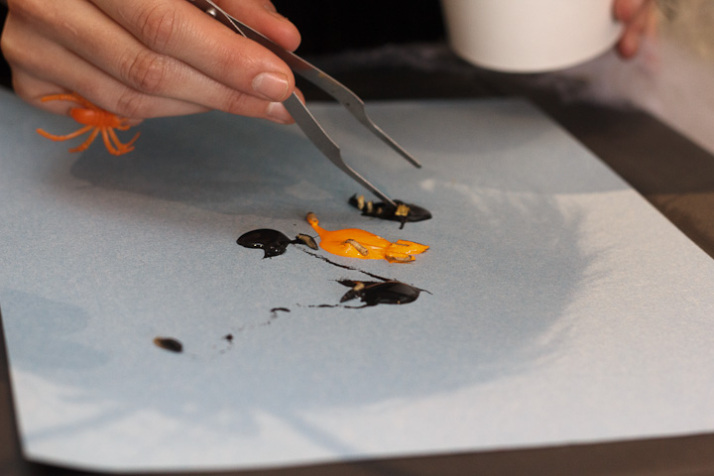
Maggots crawl through paint to create the masterpiece (Photo: Sean McCann).
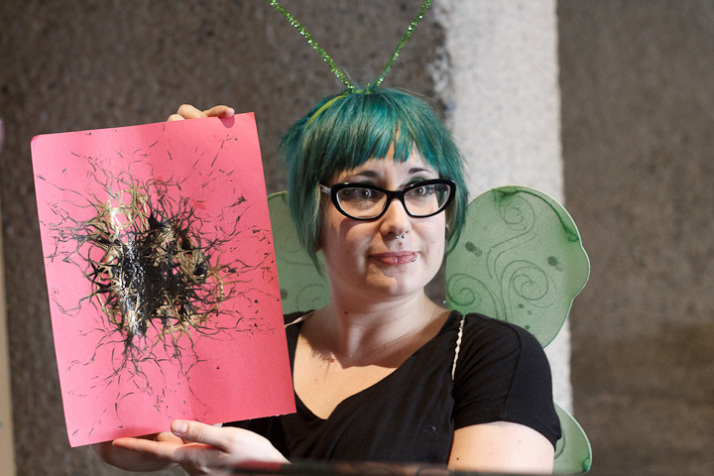
Antonia with the maggot masterpiece (Photo: Sean McCann).
3. pollination. Although I love them, I think bees are totally over-rated when it comes to pollination. In fact, honey bees are not native to North America! So, before the honey bees were brought here, guess who was pollinating our wild flowers? Flies! (Okay, credit is also due to solitary bees, beetles, and butterflies) Blow flies are excellent pollinators and, on certain plants, are incredibly effective at transferring pollen grains onto a flower stigmas (King et al. 2013).

Blow fly covered in pollen grains (Photo: Mike Hraber).
4. Measuring Biodiversity. Scientist extract DNA samples from the guts of blow flies and use their last meal (carrion and/ or faeces) to assess exactly which animals they had been feeding from (Calvignac-Spencer et al. 2013). The gut contents of blow flies provide essential data about species abundance and distribution. In places where it is difficult for people to survey (dense jungle environments) or when animals are difficult to find (nocturnal, rare, shy) the blow flies do surveys and data collection for conservationists. The information is used then to update current inventories of wild animal communities, and identify conservation strategies.
5. Beauty. Beauty is in the eye of the beholder but, look closely and you will see a fly that is quite striking! Blow flies have an shiny, metallic green/ blue colour often with bright red eyes (so why would the red-eyed green tree frog take all the credit?)
6. Forensic Entomology. Blow flies are used to determine the time of death of a corpse. Immediately after death, a body begins to decompose and release specific odours. Using the odours produced, carrion flies are attracted to the corpse within minutes post mortem. The female flies deposit their eggs on the corpse. The eggs hatch into maggots which eat and grow on the corpse. It is the information from this life cycle, or speed of growth, that is then used to determine time of death. The timing of the blow flies is so accurate can be used to narrow the time of death down to a matter of days. This method is used in our legal system to put criminals behind bars.

Female blow flies and eggs on a vertebrate carcass (Photo: Sean McCann).
7. Flying ability. Blow flies are able to fly with such precision that we are never able to swat them. This is because of the very tiny second pair of wings called halteres, which function like mini gyroscopes and help the fly to calculate in flight maneuver instantly. Scientists use Blow flies to study flight muscles and split second flight maneuvers. They have discovered flies in mid-turn have the ability to roll on their sides 90º or more (flying upside down) just like a jet fighter (Hines 2014).
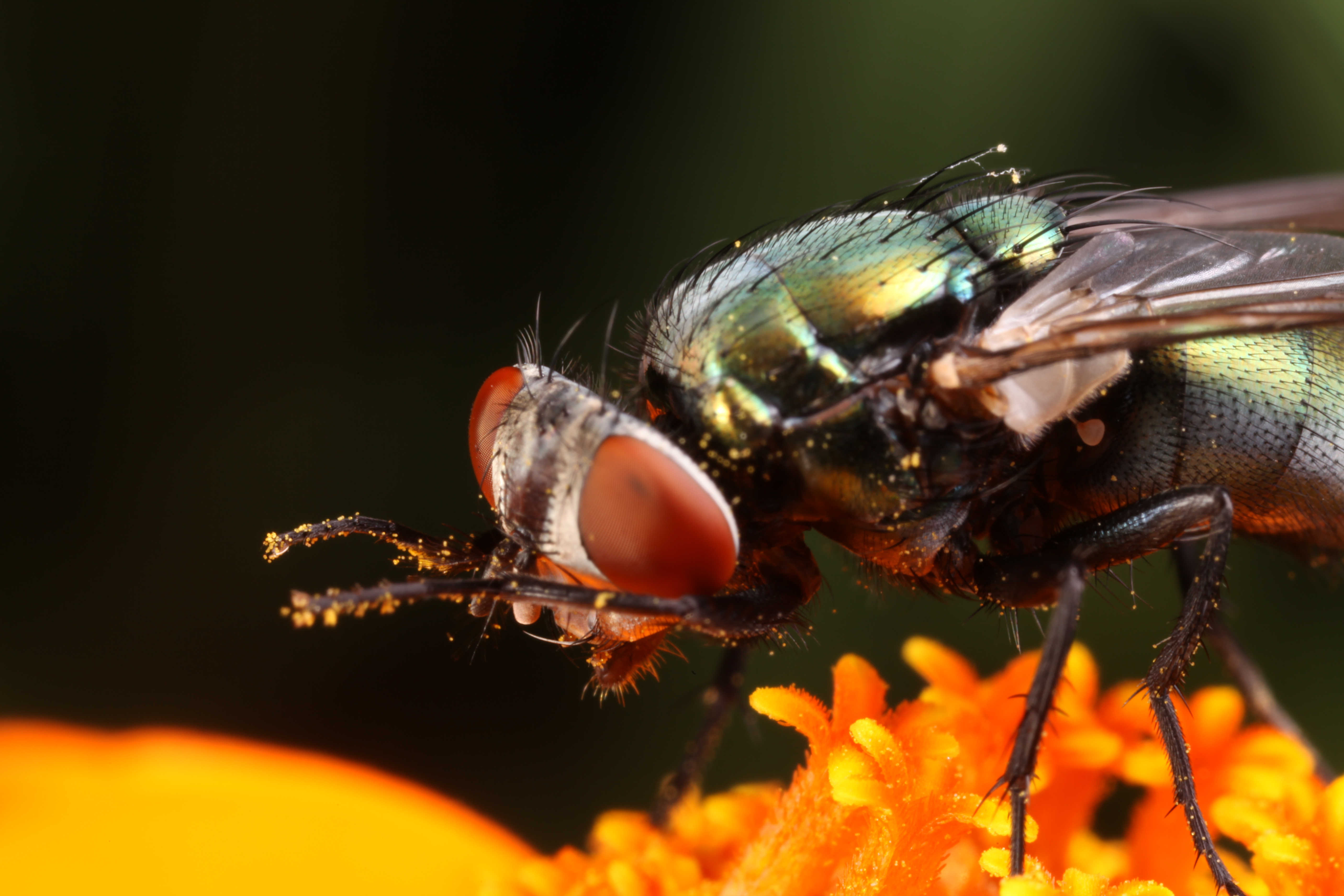
The halteres are the tiny drumstick-like wings. Located on this photo just beneath the large wings between the thorax and abdomen (Photo: Mike Hraber).

Blow fly coming in to land on a rat corpse (Photo: Sean McCann)
8. Maggot therapy. Blow fly maggots, or ‘medical maggots’, are used in hospitals to clean wounds because they are faster and more efficient than modern technology. The maggots of certain blow fly species are applied to chronic wounds, like ulcers and non-healing traumatic or post surgical wounds, because they eat only dead and necrotic tissue. The practice of maggot therapy began during World War I, surgeons used them to clean gangrene infections. Unfortunately, at the time they didn’t know which blow flies to use (some species eat dead tissues and others eat live) and the treatment worked only 50% of the time. Fortunately, we know more about these blow flies now and the method is now 100% effective. In Canada (as well as in Japan and European Union) the maggots are classified as drugs and require a full marketing licence.

Blow fly maggots are used to treat wounds that won’t heal (Photo: Jaroslaw Wojcik)
9. The movie ‘The Fly’. OK, it probably wasn’t exactly blow flies hat inspired these movies, but who cares…? Arguably Jeff Goldblum is even more handsome as a fly! The 1958 film was so popular Hollywood did a re-make in 1986. Many people think this is one of the best horror films… average rating 7.2/10 (for the first, 1958 version) and 8.2/10 (for the 1986, Goldbloom version) on Rotten Tomatoes. Don’t watch if you have a fly phobia (also called pteronarcophobia)!

Kurt Neumann’s The Fly (1958) film poster

David Cronenberg’s The Fly (1986) film poster
10. Fish food. Long before David Suzuki came up with the idea, Jason Drew has been using maggots to feed farm reared fish. Farm raised salmon, trout, and shrimp need a lot of protein in their diet. Currently the fish farming industry fishes small wild fish out of the ocean, grinds them up into fish meal, and feeds it to the farmed fish. Drew has developed an alternative and sustainable method to fulfill their protein requirements; he has been rearing blow flies on blood left over from slaughter houses and feeding the maggots to the farmed fish (Barclay 2012). This ideas has been so lucrative that he has opened his own business, Agriprotein, and is trying to license and expand the technology.
and lastly,
11. The Blow Fly. The first dirty rapper (disclaimer: NOT for all audiences; very dirty rapper)! He wrote all his songs in the 60’s and 70’s… classic. He got his name because his Grandmother said the was, “nastier than a blow fly”. He’s also the nemesis of my PhD, every time I Google something legitimate for my research, something undoubtedly pops up about this guy. He’s neither awesome or stink’n awesome… but I felt like he needed to be be listed. So, he’s number 11.

The Weird World Of Blowfly (2010) Movie Poster
Citations:
Barclay, E. 2012. How Fly Farming May Help More Fish Stay in the Sea. Retrieved from http://www.npr.org/blogs/thesalt/2012/10/15/162961073/how-fly-farming-may-help-more-fish-stay-in-the-sea on 19 May 2014.
Calvignac-Spencer S., Merkel K., Kutzner N., Kühl H, Boesch C., Kappeler P., Metzger S., Schubert G., and Leedertz F. 2013. Carrion fly-derived DNA as a tool for comprehensive and cost-effective assessment of mammalian biodiversity. Molecular Ecology 22: 915-924.
Čičkova H et al. (2102) Biodegradation of Pig Manure by the Housefly, Musca domestica: A Viable Ecological Strategy for Pig Manure Management. PLoS ONE.http://www.plosone.org/article/info%3Adoi%2F10.1371%2Fjournal.pone.0032798 . DOI: 10.1371/journal.pone.0032798.
Hines S. (2014) Fruit Flies, Fighter Jets use similar nimble tactics when under attack. Retrieved 20 May 2014 from http://www.washington.edu/news/2014/04/10/fruit-flies-fighter-jets-use-similar-nimble-tactics-when-under-attack/
King C., Ballantyne G., and Willmer P.G. 2013. Why flower visitation is a poor proxy for pollination: measuring single-visit pollen deposition, with implications for pollination networks and conservation. Methods in Ecology and Evolution. 4: 811-818.
Wajcik J. 2014. Blow fly maggots [photograph] Retrieved 19 May 2014 from http://www.straight.com/life/hungry-maggots-crawl-modern-medicine





 BRODIE BUG LAB