
THE PROJECT
The spotted lanternfly… They are EVERYWHERE! You have probably seen them around your home, in the streets of NYC, and even clumped together on trees in the park. It is safe to say that these pests are causing quite a nuisance. Local officials have gone as far as encouraging residents to squish them on sight, and New Yorkers have taken this task seriously. This urgent action is necessary because, besides being annoying, the spotted lanternflies pose a threat to woody plants
The spotted lanternfly, Lycorma delicatula, is an introduced planthopper that feeds on a wide rage of plants including red maple, black cherry, and apple trees, putting NY vineyards and crops at risk. In response to growing concern, public officials such as Senator Chuck Schumer issued a call to action last year, urging education, monitoring and management efforts (Schumer Reveals, 2022).
But despite the urgency, we still know surprisingly little about how these insects interact with each other and their environment.
WHAT WE ARE STUDYING
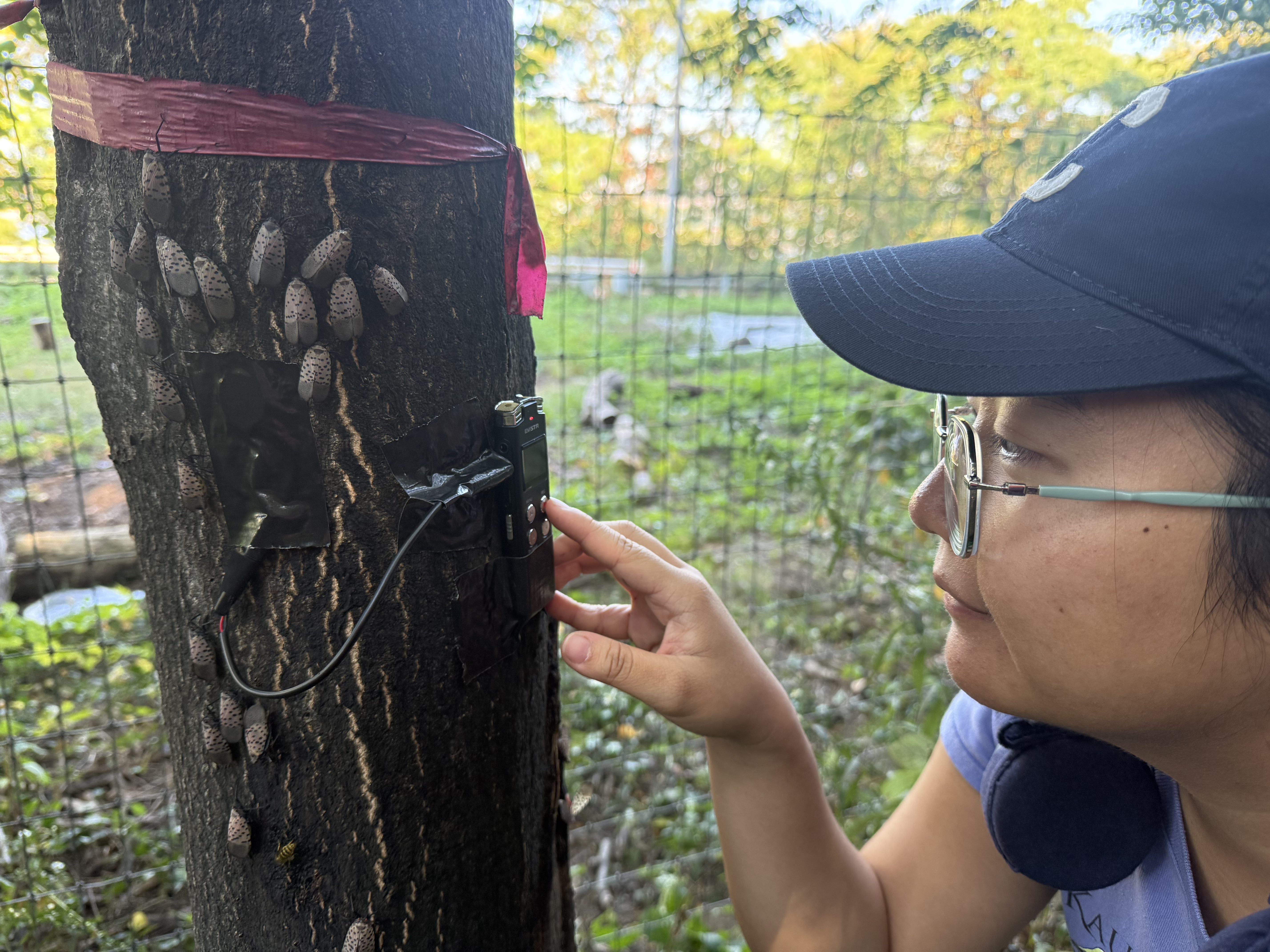
Our research examines how spotted lanternflies organize themselves in space and exchange information within their environment. We focus on three interconnected components of their biology: vibratory communication, aggregation behavior, and microhabitat use. Unlike many planthoppers that rely on airborne sound (e.g. cicadas), spotted lanternflies communicate primarily through substrate-borne vibrations that travel along the stems and trunks of the plants they inhabit. These signals move through wood and vascular tissue, allowing individuals to locate mates, coordinate behavior, and potentially assess nearby competitors. In our lab, we have directly recorded these vibrational signals using a laser vibrometer, which allows us to detect minute movements of the bug and plant surface without physically contacting the substrate. This approach enables us to quantify signal structure, amplitude, and transmission dynamics under different environmental conditions. We investigate how these vibrations are produced and transmitted, how environmental context such as plant architecture (or any material substrate they are on) affect signal quality, and why lanternflies cluster so densely on certain hosts. By mapping these communication pathways, we begin to uncover the social and reproductive networks that structure populations in real landscapes.
THE BUG
Contrary to its name, the spotted lanternfly (Lycorma delicatula) is actually a true bug (Family Hemiptera) and not a fly (Family Diptera which includes house flies and mosquitos). It undergoes a developmental cycle, progressing from an egg to nymph, and finally reaching adulthood. The life cycle of the spotted lanternfly spans throughout the summer, with distinct stages appearing at different times. In early spring, the eggs hatch, and the nymphs emerge. These nymphs are initially black with white dots then turn red with white dots as they grow. By mid-summer, the nymphs molt into adults, featuring spotted, gray forewings with red hind wings. Arguably, it is a very pretty bug!
Although the spotted lanternfly doesn’t bite or harm humans, its consumption of a variety of trees and plants, especially in large populations, has the potential to cause significant damage.

CALL TO ACTION
What can you do to help? If you see it, squish it (very effective at killing the bug). Once you’ve dealt with the bug, make sure to report it to the State Department of Agriculture (in New York state email spottedlanternfly@agriculture.ny.gov). Many areas in the tri-state region are under a spotted lanternfly quarantine, so it is crucial to comply with regulations, particularly when traveling. As Spring approaches, consider reaching out to your local park about and participate in an “Easter” Egg Hunt: spotted lantern bug edition. Folks get together to hunt for, and squish, spotted lanternfly eggs. Our lab usually attends the Egg hunt at Greenwoods Cemetery in Brooklyn, NYC.
THE STORIES
Links to our labs research or features in news and media are listed here or follow on Instagram (@bugswithbekka) for live research updates.
- Stopping the Stomp: Reconsidering the campaign against the spotted lanternfly. (2025, November 12). Columbia University School of Professional Studies. https://sps.columbia.edu/news/stopping-stomp-reconsidering-campaign-against-spotted-lanternfly
- Poulos, K.E., Y. Muñoz, M. Palmer, B.S. Brodie. 2025. Investigation of plant associations with the spotted lanternfly (Lycorma delicatula) across developmental stages using iNaturalist photos from New York. Journal of Agricultural and Urban Entomology. (Featured in BioOne complete’s Top and Trending Research, July 2025)
- Lanternfly Egg Masses Can Survive Winter! New Yorkers are stomping, scraping, and even vacuuming them away! Featuring Master student, Katherine Poulos. Published February 17, 2023.
- Masters Student, Katherine Poulos, is interviewed for a Columbia Spectator article, “Spotted Lanternfly numbers are flying high in New York, as the small insects are wreaking havoc on local ecosystems“. Published September 27, 2022.
 BRODIE BUG LAB